
Address
No.265 Shiji Avenue, Shuitou Town, Nan'an City, Fujian Province, China
Work Hours
Mon - Fri 9:00 AM - 6:00 PM (GMT+8)
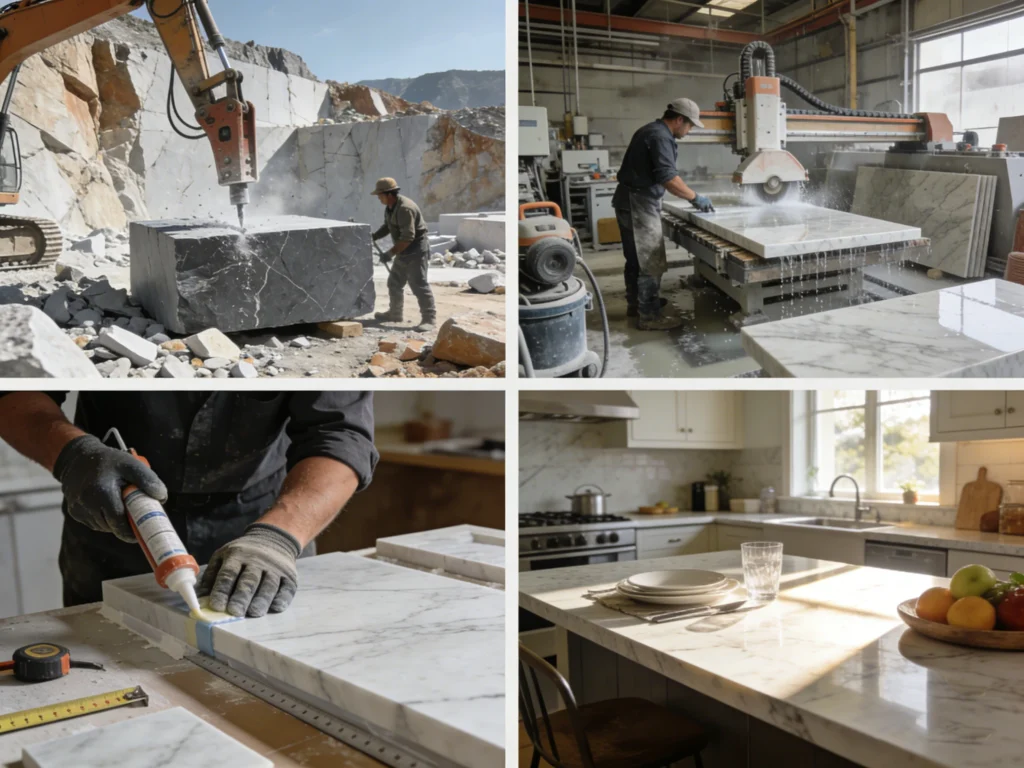
If you’re looking for a detailed guide on the marble countertop manufacturing process, you’ve come to the right place. This article breaks down every step from raw block extraction to finished product, helping homeowners, interior designers, and B2B buyers understand how high-quality marble countertops are made.
Marble countertops are a timeless choice for high-end homes, hotels, villas, and commercial spaces. They are beloved for their naturally unique veins, luxurious texture, and long-lasting durability—key reasons why the marble countertop manufacturing process requires precision and expertise.
For homeowners, interior designers, and B2B buyers alike, understanding the marble countertop manufacturing process is crucial. It helps you identify high-quality marble countertop products, avoid purchasing pitfalls, and make informed decisions when selecting suppliers or customizing your ideal countertop.
The total production time depends on the size, complexity, and order quantity. For a standard residential marble countertop, the production process takes 7-14 days.
For large commercial orders or custom designs, it may take 2-4 weeks. Additionally, shipping time (especially for international orders) should be considered separately.
Yes, marble countertops are durable and long-lasting when properly protected and maintained. The surface sealant prevents stains and damage.
The natural density of marble makes it resistant to scratches and heat (though trivets are recommended for hot pots and pans). Avoid direct impact with heavy objects to prevent chipping.
Natural marble is quarried from natural stone, with unique veins and colors that cannot be replicated.
Engineered marble is made from crushed marble and resin, featuring a more uniform appearance and better stain resistance. Natural marble is ideal for high-end, unique designs, while engineered marble is practical for high-traffic areas with strict stain requirements.
It is recommended to reseal your marble countertop every 1-3 years, depending on usage.
High-traffic areas (like kitchens) or areas exposed to frequent spills (such as bar countertops) may need resealing every 6-12 months.
A simple water bead test can check if resealing is needed: if water no longer beads on the surface, it’s time to reapply the sealant.
Yes, but not all marble is suitable for outdoor use. Choose marble with high density and low water absorption (such as Carrara or Calacatta marble).
Ensure it is sealed with an outdoor-specific penetrating sealant, and avoid using marble in areas with extreme temperature fluctuations or heavy rain, as this may cause cracking or discoloration over time.